

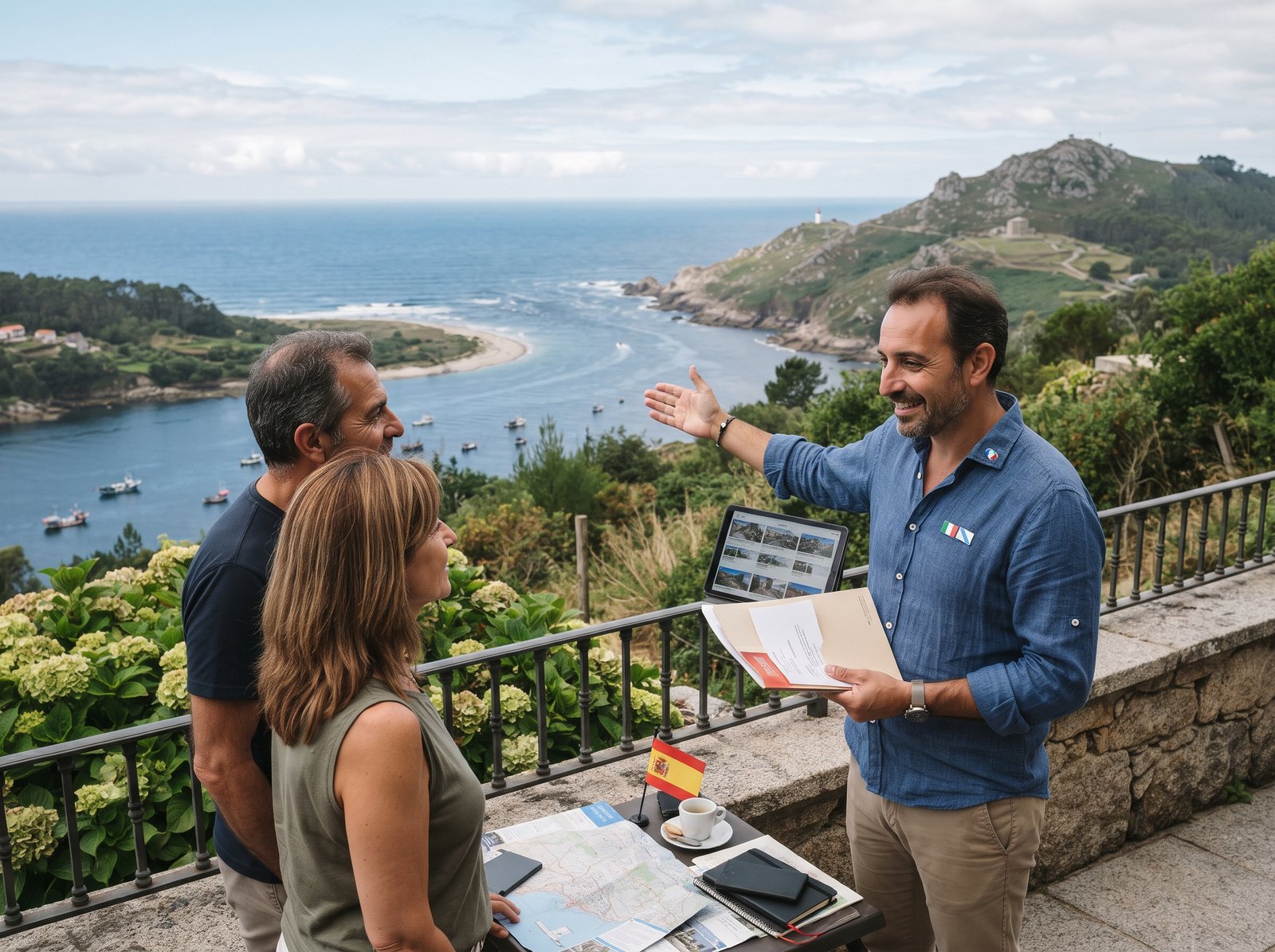
Galicia has become my home after many years spent in Italy.
It was easy to fall in love with this green, Atlantic and windy region, still unspoilt by mass
tourism.
I didn’t really know where Galicia was, but looking closely at the atlas I had as a teenager, I saw
these curious strips of sea cutting into the land and wondered if one day I might be able to visit
them.
The opportunity arose almost twenty years later when, together with my Galician wife and my
son, we left Rome with a one-way ticket to start a new life.
I am Paolo Rosi, I have worked in Rome as IT technician, later, sales representative and
freelance consultant; a 4×4 off-roader; lover of beautiful nature and the sea, yet also a city-
dweller and a music enthusiast (of a certain sort).
I live in Camposancos, a small village of a thousand inhabitants in the municipality of A Guardia
(Baixo Miño), between the Atlantic Ocean and the Miño – Galicia’s most important river, which
forms the border with Portugal.
It is an almost ‘end-of-the-line’ destination, not a place of passage, but one you reach because
you choose to.
Here the sea crashes powerfully; there is a rich seafaring culture, and the traditions of a small
village still endure.
As well as my work as a Personal Shopper, I am an Accredited Guide for the Galician Atlantic
Islands Maritime National Park, established in 2002 – an archipelago comprising four rocky and
wild islands situated at the entrance to the Rías Baixas (southern fjord)
Generally speaking, most travellers arriving in Galicia are so-called ‘pilgrims’ undertaking the
‘Way of St James’, either from Portugal – crossing the River Miño in small boats right where I
live – or from Roncesvalles (France), travelling over 800 km (on foot, by bicycle or by any other
non-motorised means) to Finisterre – a three-day walk from Santiago, considered by the
Romans to be the end of the world. These are often small groups of people from a middle-to-
upper socio-cultural background.
I enjoy getting to know Italians who come to live here in Galicia, just like me, and helping them
settle into life here, particularly with the important decision of choosing both their location
and their property.
I remember my first trip to discover Galicia, travelling by car from Italy with a friend all the way
to Vigo; a long and beautiful journey through small seaside villages, countryside, impressive
cliffs, lighthouses and mountains – a very varied landscape and delicious food at reasonable
prices (especially the fish).
After that trip, and thanks to my wife, we have returned to Galicia every summer, discovering,
time and again, beautiful corners of the region, including the inland, more mountainous areas,
and the provinces of Lugo, Ourense and A Coruña.
Many Italians are probably more inclined to travel along Spain’s entire Mediterranean coast,
where tourism is more focused on sun, beaches, parasols and sun loungers, and tends to be
more mass-market, with prices very similar to those in major European capitals.
Tourism is becoming increasingly significant, particularly in certain specific areas of Galicia,
thanks to the fine summer weather with daylight until 11 pm, the milder water temperature,
excellent facilities and reasonable prices.
The autonomous community of Galicia is slightly larger than Piemonte; it has around 1,500 km
of rugged, granite-cliffed and inaccessible coastline with wide beaches. Yet it has fewer
inhabitants than Rome, and for me this equates to quality of life and tranquillity.
The climate in Galicia is fairly mild all year round; on the Atlantic coast, temperatures rarely
drop below 7 degrees in winter, whilst in summer they hover around 25–30 degrees, which is
why Galicia can easily be described as a climatic haven.
The Baixo Miño area, where I live, is less rainy in winter than the Rías Altas (from Finisterre to
Ribadeo)
Foreign demand is mainly concentrated in three key areas:
- The Rías Baixas (Province of Pontevedra): This is the most sought-after and expensive
coastal area in Galicia. Towns such as Sanxenxo, Baiona, Cangas and Nigrán attract those
seeking beaches, marinas and a particularly mild microclimate. - The Atlantic Axis: Vigo, A Coruña and Santiago de Compostela. Santiago, in particular,
attracts foreign investors linked to the flow of pilgrims on the Camino de Santiago, who are
interested in converting properties into accommodation facilities or holiday rentals, or in living
close to the beautiful, rugged coastline. - The Rural Inland (Ribeira Sacra and the interior of Lugo/Ourense). This area is very popular
with Northern European and British buyers looking to purchase rustic properties in need of
renovation at bargain prices.
WHAT I DO AND THE SERVICES I OFFER:
I work as a Personal Shopper together with my partner Horacio Monzon, guiding overseas
clients through the process of buying property in Galicia and providing on-the-ground
assistance with mortgages and renovation work.
I also offer my expertise in opening bank accounts, dealing with tax documents and everything
else that which foreign nationals need either to come and live in Galicia or simply to be able to
purchase property in this region whilst retaining their tax status in Italy, with the support of a
trusted notary and accountant.
The typical Italian investor in Galicia is usually aged between 40 and 65; they are often a
professional working remotely, a small business owner or a pensioner.
State schools and universities in Galicia are of a very high standard, so the decision to come
and live here – even for families with children – is a real advantage and enhances quality of
life, as I have personally experienced.
The main attractions are:
Price advantages compared to the prohibitive costs of major Italian cities (Milan,
Rome) or the coasts of Sardinia and Tuscany; in Galicia, you can buy sea-view flats or
detached houses with land at attractive prices.
Cultural and gastronomic affinities: Galician culture, closely linked to food of the
highest quality (fish, seafood, meat), conviviality and wine (Albariño, Ribeira Sacra),
resonates deeply with the Italian way of life.
Nature and quality of life: the demand for ‘slow’ tourism, rather than mass tourism,
characterised by unspoilt green landscapes, cliffs, natural thermal springs, virtually
non-existent crime and a streamlined, efficient bureaucracy.
The purchase of a property in Spain by an Italian citizen (resident in Italy) is a straightforward
process, thanks to the fact that Italy is part of the European Union.
There are no restrictions on purchasing property, but the Spanish administrative process
requires certain mandatory steps to be completed before the deed of sale can be finalised.
In order to sign the deed of sale (Escritura), an Italian citizen must have the following three
items:
- A valid Italian passport or identity card.
- The N.I.E. (Número de Identidad de Extranjero). This is the tax identification number for
foreign nationals and is essential for any transaction in Spain (buying a property, paying taxes,
setting up utility services).
It can be easily obtained either in Italy at a Spanish Consulate before departure, or directly in
Spain at the Policía Nacional (by appointment). - A Spanish bank account.
Although under European law it is possible to make SEPA bank transfers from Italian banks, in
practice the vast majority of Spanish notaries and sellers require payment at the deed signing
to be made via a bank draft issued by a Spanish bank.
Furthermore, the Spanish bank account will be used to set up direct debits for future bills and
taxes.
The Offer and the ‘Contrato de Arras’ (Preliminary Agreement)
Once an agreement has been reached, the ‘Contrato de Arras Penales’ (very similar to the
Italian preliminary agreement) is signed.
The buyer pays a deposit (usually 10 per cent of the property’s value).
Important note regarding protection: If the Italian buyer withdraws, they forfeit the money
paid. If the Spanish seller withdraws, they must return double the deposit received to the
Italian buyer (Article 1454 of the Spanish Civil Code).
Costs and Taxes in SPAIN (Post-Deed)
Immediately after signing the deed (escritura), you must register the property within 30 days.
- Notary and Land Registry: The notary’s fee and the registration in the land registry cost
between 0.1% and 0.5% of the property’s value (approximately €600–€1,000 for the notary
and €400–€700 for the land registry).
Gestoría fees: The administrative agency responsible for actually paying the taxes on the
client’s behalf and registering the deed with the Land Registry (approximately €300–€500).
Annual taxes and costs in Galicia (recurring)
IBI (Impuesto sobre Bienes Inmuebles): This is the equivalent of the Italian IMU. It is paid to
the local council once a year and varies between 0.4% and 1.1% of the property’s cadastral
value (which is usually much lower than the market value).
- Rubbish Collection Charge (Basura): A fixed annual fee for waste management and sewerage
services (generally between €100 and €200 per year). - IRNR (Impuesto sobre la Renta de No Residentes – Form 210): As a resident of Italy, you must
pay this tax to the Spanish government. It is calculated in two ways: - If the property is at your disposal (for personal use): You pay a ‘notional’ tax of 19 per cent
applied to 1.1 per cent (or 2 per cent, depending on when it was last revised) of the cadastral
value. - If you let out the property: You pay 19 per cent on net rental income (you can deduct many
management expenses such as utilities, service charges, estate agent fees, repairs and even
mortgage interest). - Service charges (Comunidad) and utilities: Ordinary expenses for the upkeep of the building
and electricity and water contracts.
Obligations and Taxes in ITALY (Whilst remaining a tax resident in Italy)
Italy taxes its tax residents on income and property held worldwide (Worldwide Taxation). You
will therefore have specific tax return and tax obligations.
Annual obligations to the Italian tax authorities (Modello Redditi / 730)
Tax Reporting (Section RW): You are required to declare ownership of property in Spain in
Section RW of your Italian tax return, stating either the purchase price or the cadastral value.
- IVIE (Tax on the Value of Overseas Property): This is the Italian tax on homes abroad. The
standard rate is 1.06 per cent of the property’s value.
If you let the property (rental income): You must also declare the rent received in Italy.
How can you avoid double taxation?
The bilateral double taxation agreement between Italy and Spain protects you:
- On the property (IVIE vs IBI): You can deduct the full amount of the IBI (the Spanish IMU)
that you have already paid to the Galician local authority from the IVIE you have to pay in Italy.
If the IBI covers or exceeds the IVIE, you will not pay anything in Italy in monetary terms, but
you will still be required to declare the income. - On rental income: If you let out the property, you will first pay 19% in Spain (IRNR). In Italy,
you will declare the income but will receive a tax credit equal to the tax already paid to the
Spanish tax authorities.
WHAT IF YOU RELOCATE YOUR TAX RESIDENCE TO SPAIN? (Tax: IRPF)
If you move your tax residence to Spain, the property is no longer taxed via IRNR. You become
liable for IRPF (Impuesto sobre la Renta de las Personas Físicas), which is the standard
progressive Spanish personal income tax.
A. If the property is your main residence (Vivienda Habitual)
- Tax rate: 0%. The first home in which you reside permanently is fully exempt from the
notional income tax.
B. If the property is a second home at your disposal
- The same calculation for imputed income applies (1.1% or 2% of the cadastral value), but the
result is not taxed at a flat rate of 19%; instead, it is added to your other income (salary,
pension) and taxed according to the progressive IRPF brackets (which range from 19% to 47%
depending on your overall tax bracket) .
C. If the property is RENTED OUT (Substantial tax incentives for residents)
For residents too, rental income is added to the progressive IRPF tax base after deducting
expenses. However, if you let the property as a permanent residence to a tenant, Spanish law
provides for very substantial tax relief:
- 50% reduction: In principle, a resident letting on a long-term basis pays tax only on half of
the net profit (for example, if you earn €6,000 net, you declare only €3,000). - Up to a 90 per cent reduction: In special cases (if the property is located in high-demand
areas (A Coruña and Santiago) and you decide to reduce the rent by 5 per cent compared to
the previous tenancy agreement, or if you let to young people), the reduction in the taxable
base can be as high as 90 per cent.
I hope this has given you an overview of the taxes payable when purchasing a property in
Galicia and of my experience in this region.
Please feel free to write to me or give me a call; I’ll be happy to help you settle into life in
Galicia.
Paolo Rosi